Friday, November 2, 2012

¡Feliz día de Halloween!

Halloween is not much of a thing here. In fact the only knowledge of it is the worst kind. People in Panama City celebrate it more or less the way we do, but what appears on the news (and what arrives to the middle of nowhere) are the few incidents of people causing trouble in a cemetery or young men asking an old lady for candy, then robbing and killing the poor old woman. So unfortunately, it seems Halloween is associated with devil worship and all other superstitions, and general violence and tomfoolery. Sadly, I didn't get any support in doing an activity at school, or even so much as a short English lesson about Halloween.

However, I had a bit of fun at home. I had my Mom send me candy and other Halloween things (spider rings, pencils, etc.), which I used to make Halloween goodie bags. Then I announced to all my Elementary school kids that I would be having a little "cultural exchange" at my house, where I'd teach about trick-or-treating and pass out candy. The educational aspect sort of fell by the wayside, but it was a success nonetheless!

The decorations are a bit lackluster, but I think it was just enough to let people know that it was no ordinary day.

The kids enjoyed the goodie bags, although it led to a lesson in proper disposal of garbage. They LOVED the Batman mask I bought as part of a Halloween costume. They all wanted to try it on and run around as Batman.

The same kids who are often too shy to even attempt to answer questions in class are yelling for me to take picture after picture in endless silly poses. And I was more than willing to oblige.

Included in the goodie bags were temporary tattoos, with phrases like, Gimme candy!, Boo!, and Trick or treat! There were a bunch of other typical Halloween images, which the kids most likely had to explain to their superstitious parents. "What are you doing with a tattoo of a ghost? You know that's sacreligious..."

Notice the door is closed. No kids allowed in the sanctuary. However, the porch was a funhouse for a few hours. Everyone really enjoyed their "HopiHalouin!"

"Say Hello to my little friend!"

Last week I finally broke down and got a pet. I've been so bored while at home all by myself. So I got one from a neighbor down the street whose cat had just given birth to kittens. I'm guessing he's still about two or three months old.

His name is Maní, which is Spanish for peanut. AWWWWWWWWW!

I put a little sort of collar on him to be patriotic (one of the Panamanian Independence Days is November 3rd), but it slipped off his neck. Too bad.

He does a lot of chilling anywhere and everywhere: on the couch, on the chairs on the porch, on my lap, on top of the computer while I'm trying to do something...

This is been a huge boost in the home life department, especially since I haven't heard those mice since I got him! Companionship? No more pesky mice? Double win!

The Library Renovation Project

In the time I've been in Panama, I have spent an inordinate amount of time wishing I could make a difference, leave some sort of legacy, a noticeable impact, etc. Unfortunately, the nature of teaching makes results and effectiveness of teacers difficult to gauge. Many teachers I've talked to have said flat out that the fruits of our labor in the school will not be apparent for many years. It's all quite understandable. However, as a hard-working, goal-oriented person, it's a bit disheartening to hear that all my hard work will seem to amount to nothing in the two years I'm here. However, that might have just changed.

Recently, I've been talking with neighbors and community members. They, as usual, are discouraged that I haven't started community English classes. This pair of women phrased it better than most, citing the community's lack of initiative in setting up classes or collaborating with me. They said that I've been here for 9 months and they've yet to take advantage. "But Nick, why don't you just start the classes yourself?" Good question. Well, it's difficult to get projects done alone, especially when you're in a foreign county and culture, living in a close-knit community. If I start classes without real interest already built up in the community, it wouldn't be sustainable. They'd come one week, get bored, and stop coming. So they need to meet me half-way in anything I do here.

The conversations (by my probing) transitioned to the community library, a space used in the past for classes in literacy and other useful skills. It actually has some books, which is huge. The place used to have computers and electricity. The problem is that since no one was willing to work there for free, no one managed the space. The light bill went without paying, and so the lights eventually got cut off. Kids would take books without asking, and never returned them. You can imagine the rest of the story. Of course, I was drooling at the potential of the place and community members got excited about a new catalyst in the form of a Peace Corps volunteer.

Step 1 was getting the key. It turned out to be a wild goose chase. One person said they gave the key to Fulano (So-and-so), who then gave it to someone else to use this day. I went to no less than 5 different people, but I tracked it down. I now hold on to that key with my life. If I didn't, who knows what could happen?

The next step is cleaning up the place. It's not too bad, but there are bats hiding all in the roof and behind the circuit breakers (or whatever they're called). So that'll take some doing. I started by my lonesome, but some kids have helped on occasion. A few ladies have come as well to help.

After that I want to form a library committee to make the project more formal. That has proven unusually difficult. Ladies are willing to sign my little declaration, but we've set up meetings to get more involved. Two meetings and abysmal attendance have me down, but it's the culture. People say they'll come to your meeting. "Of course," they reply. And then they don't show up...

I'd like to:
-repaint the walls
-possibly redo the floor
-stock the place with new books, encyclopedias, children's stories in Spanish and English
-get new tables, chairs, a whiteboard (and possibly, possibly high-tech items like a copy machine, projector, etc.)
-start my English class by the new school year, end of February into March
-get an Infoplaza (internet cafe, more or less) in the space

We'll see how it goes. I'm gonna need a lot of help.

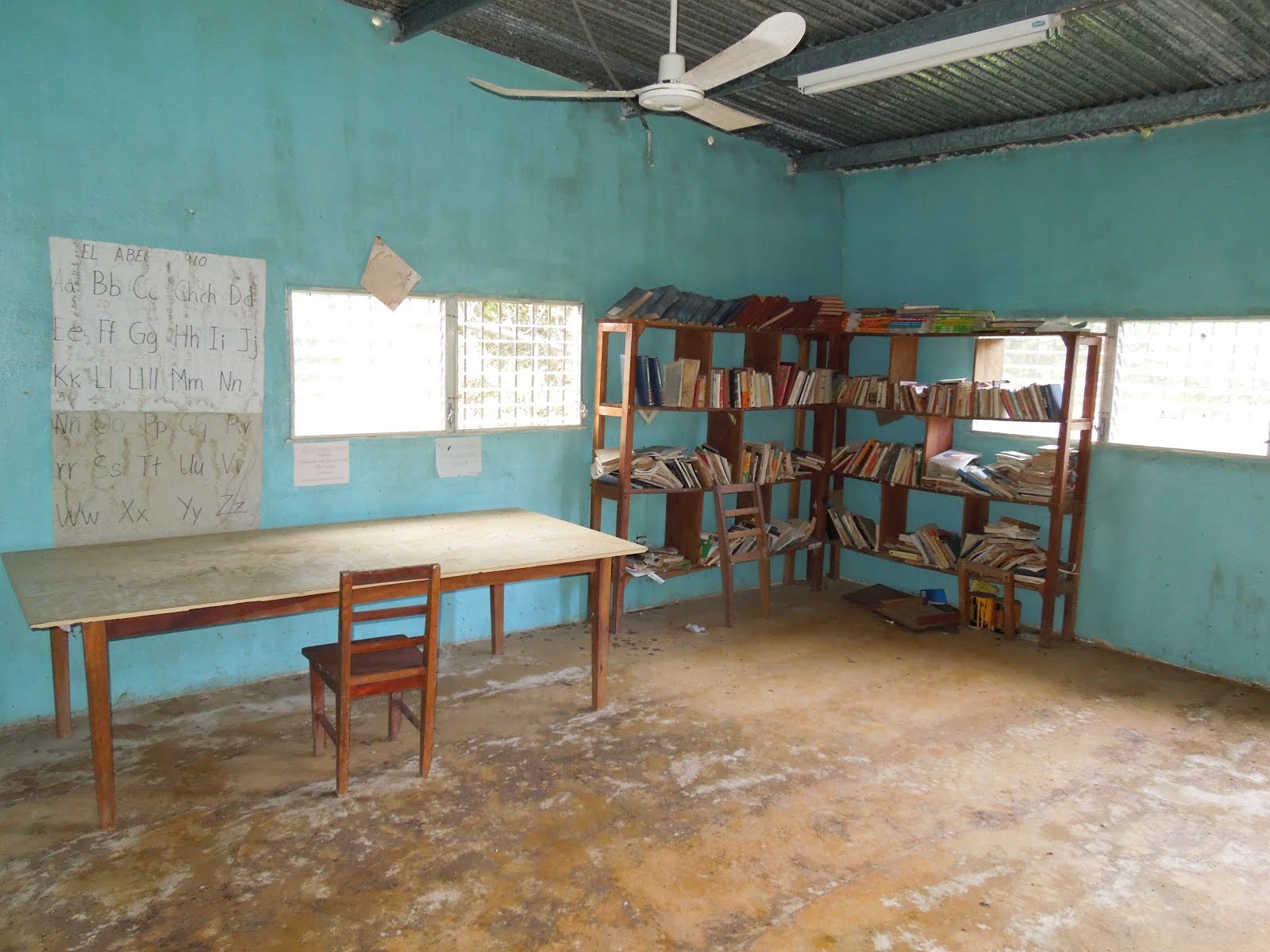
This doesn't look as bad from a distance. Perhaps I should have taken close-ups of the dust and gunk everywhere. Aside from that, it's a great space. And it actually has books, some of which are worth keeping!

This is the other side of the space, which I'd like to convert into an internet cafe. It's supposedly a "streamlined" process, seeing as how there's money in the federal budget to build these Infoplazas all across the country. As soon as we can write a letter to our representative, we'll have to wait. But even before that, we need to get a committee together.

Also, you'll notice chéchere in the corner. This is one of my favorite new words: it's a technical term for junk. People use it all the time.

Aside from the standard cleaning, we have to combat critters like bats in the ceiling and wasps' nests in all the windows. Bright side: we have windows with screens.

The possibilities are endless, and with the support from my community, this could be that one thing I've been searching for in my service, that brass ring.

Monday, October 15, 2012

Fiddler on the Roof (in Spanish) at the Teatro Nacional and more!

It's great to have friends. The two people I know from Panama have both gotten in contact with me since I've been in country. One of them was working on a show in the city and invited me to see it and hang out for the weekend. They were (or still are, I suppose, since the run ends today) doing Fiddler on the Roof. It was the first time I got to see theatre here in Panama. I couldn't pass it up!

The show was wonderful, and a very interesting experience. I've been in Fiddler before, so I'm very familiar with the music and the show in general. It was odd seeing it performed in Spanish, with translated songs. "To life, to life, L'Chaim!" became "Brindemos por la vida!" (Let's toast to life!) So it often worked out wonderfully and I understood without any problem. There were other moments where I had to laugh at the strange Spanish I was hearing. Casamentera (their word for Matchmaker) is one I've never heard before and will likely never hear again. But the overall message stayed the same, and I thoroughly enjoyed the show.

Un violinista sobre el tejado, playing at the Teatro Nacional in Casco Viejo, Panama City. A gorgeous venue.

(The front entrance)

Everyone and their mother was taking pictures of the beautiful stage with their smartphones before the show started. It was a bit of a shock, coming from my site to the city, and such a yeyé (upper class) experience as the theatre.

A very classic interior, with several balconies for small group seating. The first time I saw it, my mind immediately went to Abraham Lincoln. Abe, no!

My University of Michigan and Panamanian friend. Thanks Andrés for a great weekend!

Thursday, October 4, 2012

I.P.T. School Anniversary

Quick review of what I.P.T. means before I launch into the real content. I.P.T. stands for Instituto Profesional y Tecnico. It's a term referring to the type of school. There are two levels: pre-media, middle school including 7th, 8th, and 9th grades, and media, 10th, 11th, and 12th grades with a sort of major. In the case of our school, the media program's focus is agriculture. The high school kids spent a lot of time learning about crops, working out in the fields, and learning to use machinery.

This past Thursday was the I.P.T.'s school anniversary. The festivities are pretty standard across the country, but compared to the elementary school's anniversary, this one was a bit different for me. Namely, the theme was more traditional Panamanian as opposed to the rural, "cowboy" theme. But like any other Panamanian celebration, dancing and eating were major themes of the day.

On Wednesday night, teachers stayed and prepared the school for the next day. Then, that evening, they had a procession with all the teachers and students, a kinda sorta drumline, and torches. It was very interesting. Everyone in the community emerged from their houses to join the procession, which went from the school to the church (about a 4-minute walk).

Thursday, September 27, was the big day. And just how exactly did we know it was a big day? Cars were parked in front of the school. Barely anyone in my community has a car, so that means people from elsewhere came out.

One of the fun activities they had was a tug-o-war with a nearby school (the same school where I took a group of kids to recite the poem I wrote back during English Week). The visitors won every round of the game. They were bigger, and one kid looked like a bodybuilder in training. Beastly...

The school named a student queen (not pictured here). They also had a faculty king and queen. I lost in a very close race. I think the applause-o-meter was faulty. The two here are high school students in ropa típica, traditional Panamanian clothes. The men ususally wear collared shirt like that (occasionally with designs), jeans or dark pants, cutarras (sandals), and a chácara (small, handwoven bag).

The girl here is from a neighboring community's conjunto típico, a traditional dance group. She is wearing what is called a pollera, a beautiful dress, wonderfully ornate and elaborately, painstakingly handmade (especially with the authentic, expensive ones).

Here you can see the sort of headdress the girls wear to accompany the pollera.

An interesting stand brought to us by ARAP, which is essentially the Acquatic Protection Agency. They set up acquariums with different fish and sea creatures with a small blurb about each one.